
An unexpected path to astrophysics
An unexpected path into astrophysics has led CIS Class of 2020 graduate Leilei Reinosuke Kusano to research black holes and the mysteries of gravity. In this Q&A, he reflects on how the IB prepared him for research, his love of music and the sense of belonging he still feels when returning to CIS.
When did you realise that astrophysics was something you wanted to study at university?
When I started my Master of Physics degree in 2020 at the University of St Andrews in theoretical physics, I actually didn’t have my sights set on astronomy or astrophysics at all. In this respect, I stumbled onto astrophysics almost by accident.
As our CIS Class of 2020 cohort finished our IB in the middle of the Covid pandemic, I completed the first few years of my university degree online from Denmark, doing research in materials science on the side. When I finally got to attend university in person, I was quite desperate to gain some research experience with the faculty as well. A field that many of my peers were interested in, which influenced my decision quite a bit, happened to be in observational astrophysics.
Having done a summer internship in 2024 on high-energy astrophysics, I realised that I really enjoyed doing physics research. In this respect, I didn’t really even know if astrophysics was my thing until recently. Now, together with theoretical gravitational physics, it forms one of my two main pillars of research.

What did you study at CIS that helped prepare you for astrophysics?
During the IB program at CIS, I did Mathematics, Physics, Chemistry, and English Language/Literature at Higher Level, while also doing History and German B at Standard Level.
Naturally, I would say that the STEM subjects (math, physics, chemistry) were essential in building up my basic toolkit that I use in conducting my research. Aside from the topical relevance, they also trained my mental stamina a lot. These subjects no longer deal with trivial problems at the high school/IB level, so you have to get used to sitting and thinking about one given problem for a long period of time. This is a crucial skill especially in research. As a researcher, you are doing something that nobody else has done before, and you have to come up with the explanations to your results by yourself. Doing the IAs was also great fun, especially when supervised by teachers like Fred, Mr Boulton, and Mr McIntyre.
I was really lucky to learn from some great teachers (Ms Prisk, Ms Nyiendo, Frau Reichert, Ms Donnellan) that good structure and clarity is essential.
Leilei Kusano
The skills that I gained from my other subjects (English, history, German B, Theory of Knowledge) play a crucial part in my current work too. When doing research in STEM, publishing results and communicating their significance to the broader scientific community is very important. It’s really easy to write a paper that nobody else understands, which is a fact that a lot of researchers seem to overlook! Good communication of any form should elucidate rather than obfuscate, and I was really lucky to learn from some great teachers (Ms Prisk, Ms Nyiendo, Frau Reichert, Ms Donnellan) that good structure and clarity is essential.
I think the IB program is exemplary in this regard. It aims to develop students holistically, through allowing them to interact with a multitude of different areas and hone many different types of skills throughout the two years of their degree.
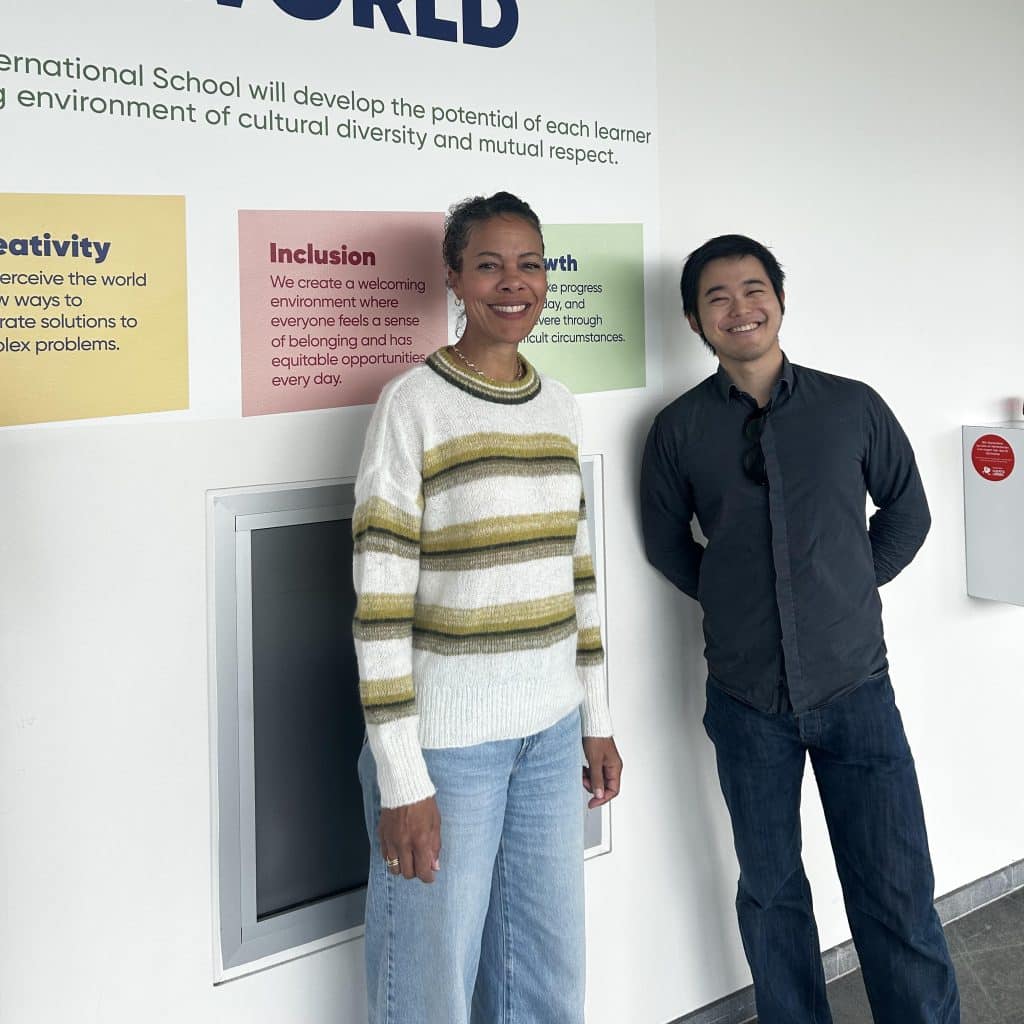
For someone who doesn’t know much about astrophysics, how would you describe what you actually study? And where do you hope to be in 5 years time?
The tagline that I use to describe my research is “Compact objects at all scales”. More specifically, I mainly work on black holes and other such objects from both theoretical and observational perspectives.
Newton’s gravity and Einstein’s theory of relativity work well at the scales of planetary and solar systems. However, once we zoom out to galaxies and the greater cosmos, or focus in on (sub)atomic levels, we encounter some issues with our gravitational theories for which we require some additional ingredients.
My research explores some possibilities to fill these gaps, and discusses what happens when we rely on other theories or make large assumptions about the underlying physics. For example, a lot of my recent work has concerned the possibilities for different black hole structures arising in alternate gravity theories. I also work on a theoretical model wherein quantum particles trap themselves in their own gravitational potential. It’s speculative research, but it is a lot of fun!
On a more observational front, I work on active galactic nuclei (AGN), which host the supermassive black holes at the centres of galaxies. Since we can’t image most of these supermassive black holes directly as they’re often too far away for our telescopes, we instead look at how light near these objects echoes across space to understand the structures of their environments.
As for what I’d be doing in five years’ time, hopefully I’ll be finishing a PhD, either in astrophysics, mathematical physics, or theoretical physics.
You were a wonderful violinist during your high school years, performing both as a soloist in concerts and as part of various ensembles. Have you managed to keep your love of the violin and music alive since leaving CIS?
Many thanks! I did have many great memories playing at CIS, and receiving many kind words of encouragement from members of faculty (Ms Donnellan, Ms Prisk, Ms Wykes, Mr Boulton, Mr Howard, to name a few). The charity club concert that we did in spring 2019 with the Danish opera singers, organised by Frau Reichert and Ms Faircloth, will always hold a special place in my heart.
I am afraid I no longer play much violin. I suffered an injury in autumn 2020 which unfortunately became kind of chronic. I did play on-and-off from 2022 to 2023, but then I just got too busy with university studies. My violin teacher passed away in early 2025, which also made it harder for me to pick the instrument back up.
I am fortunate that some people are still willing to hear me play. While I was at St Andrews, I had the opportunity to professionally record some newly-made violins for a local luthier (Alan McGeoch) who was kind enough to let me loan those instruments for free. I do still have a big love for music, so I hope to get back to more musicmaking soon!
After you graduate, do be sure to go back and visit CIS; the staff would love to have you back, even if just for a chat.
Leilei Kusano
Any advice for current IB students?
Study hard, but also remember to enjoy yourselves once in a while! Be sure to make many great memories.
The IB is difficult, but it is a very rewarding program. Each class is a class you will likely never experience again, so ensure that each moment of your time in the IB is as rewarding and fulfilling as can be.
After you graduate, do be sure to go back and visit CIS; the staff would love to have you back, even if just for a chat.
When you do visit, remember to take in CIS’s aquamarine-tinted solar cells paneling the walls and its towers reflected in the water of the canal. You would be surprised at how quickly that sense of belonging and homesickness comes flooding back, in remembrance of the many amazing experiences that you have had there. At least it surprises me, every time.