Operation Wallacea in Madagascar: Day 15
Day 15 – Nosy Be 27/06/24 – Thursday
Morning for qualified divers:
After waking up at 6 am in the morning with tummies full of pancakes we got ready at the dive centre to collect our diving gear. An exciting dive was awaiting us – the benthic video dive survey, which is a survey where you record a 20 meter transect line with a waterproof camera. This footage we would use and analyse later to understand the concentration of different corals at a random spot at our designated dive spot which was “Nosy Tanga”. When entering the water and descending to the sea floor we found only sand and so we had to find the reef with the beautiful corals by swimming and following the expert dive instructors. After a little swim we found the reef and we started laying down a transect of 20 meters. One person would unreality the transect tape and then the dive buddy to that person will tuck in the transect tape by tucking it carefully under corals, sea grass, rocks, etc. This ensures that the transect line does not swing around with the current is a more accurate representation of the length measured. This was a new skill we qualified divers had to develop and it was quite challenging as it was essential to maintain a good buoyancy because we did not want to bump or hit the coral, hence destroying the reef life to a small degree whilst still getting close enough to be able to tuck in the transect tape. Then after the transect tape has been placed and checked another dive pair from the same group would record directly over the transect tape and stopping every 25 cm for a brief moment. This was also a challenge as the current hindered the diver in keeping a straight line with the transect tape and also being able to stop the movement every 25cm.
The first benthic video transect survey took us almost 30 minutes as we had problems and challenges along the way with straight filming and tangling of the transect line. Whereas the second one was a little faster and took us around 15 minutes as we had learned from past challenges and improved.
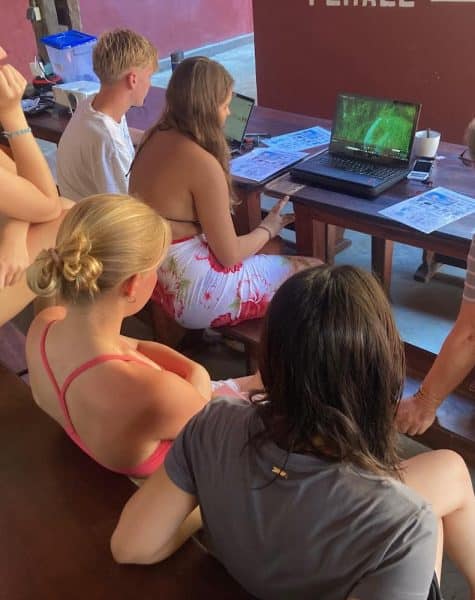
After our dive was finished we had video analysis workshop where we would analyse the videos we had just collected from the dive. We would pause the video every time the video had passed a distance of 25 cm hence the the brief pauses in motion when filming. At every pause we would record the different types of corals that we could find close to the recorded transect line. This information allows us to understand the frequency of different corals in Madagascar and more specifically Nosy Tanga which we can use to help increasing the safety of the reef.
In the afternoon, an equally exciting dive was ahead. Our pre-dive workshop introduced us to an organisation called CoralWatch, which was built as a research project by the University of Queensland, in Australia. CoralWatch’s goal is to monitor and protect coral reefs around the world by providing people with a DIY coral health monitoring kit. Each of us divers were to randomly choose 20 different corals, then identify what type of coral they were and their lightest/darkest shades in comparison to the CoralWatch reef health colour sheet.
As we descended down to the reef in Nosy Tanga, we stumbled upon loads of marine life. Shoals of fish dotted the reefs, bigger ones hid under table corals, and we spotted a lone lionfish sat in the sands right under our entry point. While admiring the wildlife, each of us selected and collected data on our corals using underwater slates, and once we returned to the hostel, we reviewed and sent to the University on the CoralWatch website. The data sent included not only our observations (the shades of colour of coral), but the location, time, depth, and weather conditions for accuracy.
An important thing to note is that the health charts provided by CoralWatch consist of only four colour gradients, which are mostly green, burgundy, and brown. We learned during our workshop that this is because while there are plenty of multicoloured corals, many of those colours can also be indicative of disease. Therefore, we couldn’t record a purple coral as purple, because it may not naturally be that colour.
Alongside our data submission was a quick lecture given by OpWall staff on mangroves and seagrasses. Specifically, their importance for the environment – both as nutrient and carbon sinks – adaptations for survival, and their current threats. Many of which had to do with deforestation/habitat destruction by the fishing, shrimp-farming, and tourism industries.
All in all, we learned a lot about determining the health of a reef, and the importance of the protection and restoration of mangrove and seagrass environments, and we really enjoyed our last day diving!
Otto Christian Poulsen and Aviaja Wachter
Morning for almost-qualified divers:
This morning we had our last official mandatory dive before receiving our certification this afternoon. The dive began at 10:30 and before hand we spent our mornings filling ourselves up with energy from Nose Be’s amazing pancakes and fruit juice! We can’t forget about us also completing an early morning Lecture about different fish species and their importance.
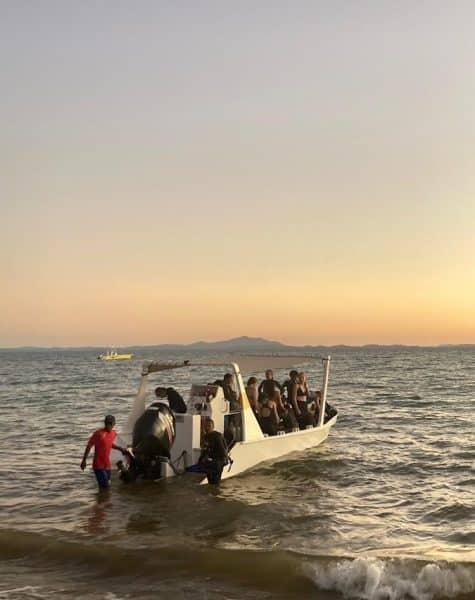
At 10:30 the groups assembled at the dive gear collection point and we excitedly put on our wetsuits in hopes to complete the final mandatory dive before the afternoon “fun free dive” where we would later recieve our certifications. We, full of emotions, speedily put on our wetsuits, grabbed our gear and speed walked toward the boat. On the boat we set up our stuff, got our marine computers and compasses and set off for the final mandatory dive. Each group said that the dive, as usual, was amazing and in one way it was already a fun free dive because we only had a few exersises to complete such as the “tow” exercise where we practiced saving each other in case of an emergency, in my opinion taking the activity seriously was the hardest part of the course since we couldn’t stop laughing at the fact that we had to drag one another through the ocean in a variety of funny positions.
All in all, we enjoyed the first dive and seeing all of the coral reefs made us feel even better and more ambitious for the fun coral reef exploration dive waiting for us this afternoon.
The afternoon dive was utterly amazing! Not only did we get to dive into the water in super fun ways but we also saw 3 marbled rays which are extremely rare on the island, they were as big as me! We also saw hundreds of new fish species and lots of different corals, it felt surreal after all of the hard work! Overall the dives we even better than we could’ve ever hoped and by the end of the day my group was ecstatic, WE ALL PASSED!
Simreen